
Beautiful and Strange Old Cars
-
agreed, the mustang body type is not a good match to that style of car, plus all the good things of that style of car are not exactly done as tastefully as they were on the originals.
-
Benz Patent-Motorwagen
The Benz Patent-Motorwagen (or motorcar), built in 1886, is widely regarded as the first automobile; that is, a vehicle <u>designed</u> to be propelled by a motor.
The vehicle was awarded the German patent, number 37435, for which Karl Benz applied on January 29, 1886. Following official procedures, the date of the application became the patent date for the invention once the patent was granted, which occurred in November of that year.
Benz officially unveiled his invention to the public on July 3, 1886, on the Ringstrasse (Ringstraße) in Mannheim, Germany.
About 25 Patent Motorwagens were built between 1886 and 1893.
Bertha Benz, married to Karl, chose to publicize the Patent-Motorwagen in a unique manner: She took the Patent-Motorwagen No. 3, supposedly without her husband's knowledge, and drove it on the first long-distance automobile road trip to demonstrate its feasibility as a means to travel long distances.
That trip occurred in early August 1888, as the entrepreneurial lady took her sons Eugen and Richard, fifteen and fourteen years old, respectively, on a ride from Mannheim through Heidelberg, and Wiesloch (where she took on ligroin as a fuel at the city pharmacy, making it the first filling station in history), to her maternal hometown of Pforzheim.
As well as being the driver, Benz acted as mechanic on the drive, cleaning the carburetor with her hat pin and using a garter to insulate a wire. She refueled at the local pharmacy in Wiesloch and as the brakes wore down, Benz asked a local shoemaker to nail leather on the brake blocks, in doing so, inventing brake lining on the way. After sending a telegram to her husband of the arrival in Pforzheim, she spent the night at her mother's house and returned home three days later. The trip covered 194 km (121 mi) in total.
What a story! And what a charming car! :)
Benz 1885

Benz nr 3 1888, used by Bertha Benz for the first long distance journey by automobile

- YouTube
Auf YouTube findest du die angesagtesten Videos und Tracks. Außerdem kannst du eigene Inhalte hochladen und mit Freunden oder gleich der ganzen Welt teilen.

(www.youtube.com)
-
Panther started by making a Jaguar SS100 replica,and ended up doing a Gerry Anderson inspired six wheeler
-
-
-
Buick Y-Job
The Buick Y-Job was the auto industry's first concept car, produced by Buick (a division of General Motors), in 1938.
Designed by Harley J. Earl, the car had power-operated hidden headlamps, a "gunsight" hood ornament, electric windows, wraparound bumpers, flush door handles, and prefigured styling cues used by Buick until the 1950s and the vertical waterfall grille design still used by Buick today.
In 2001, Buick recreated the Y-job with modern advancements called the Buick Blackhawk drawing extensively from the Y-job.
Buick Y-Job 1938

1938

-
Le Sabre concept car
The General Motors Le Sabre was a 1951 concept car. Possibly the most important show car of the 1950s, it introduced aircraft-inspired design elements such as the wrap-around windshield and tail fins, which became common on automotive designs during the second half of the decade.
The project was a follow-up to Earl's famous 1938 Y-job. --See my previous post--
In addition to its jet inspired design, the 1951 Le Sabre also featured numerous advanced features, including a 12-volt electrical system (most cars of the period were 6-volt), heated seats, electric headlights concealed behind the center oval "jet intake" and other features.


-
Panhard Dyna Z
The Panhard Dyna Z was a lightweight motor car made by Panhard of France.
It was first presented to the press at a Paris restaurant named "Les Ambassadeurs" on 17 June 1953.
Panhard was one of the world's oldest auto manufacturers and since 1945 had become known for producing economical cars. Panhard, like Citroën, considered itself a leader, not a follower of automotive trends, and the Dyna Z had an impressive array of unusual engineering choices.
Panhard Dyna Z 1959


One of my friends still drives around in one of these occasionally.
It's a lot more fun than all those sophisticated cars of today! :D
- YouTube
Auf YouTube findest du die angesagtesten Videos und Tracks. Außerdem kannst du eigene Inhalte hochladen und mit Freunden oder gleich der ganzen Welt teilen.
(www.youtube.com)
-
As far as I’m concerned this thread, which I started on January 12, 2014, has almost run its course.
I will not post any new entries.
I hope some of you enjoyed visiting this thread and possibly will continue to do so, provided that some other people would care to carry on.
Thank you! :)
-
-

Dymaxion car
From Wikipedia, the free encyclopedia
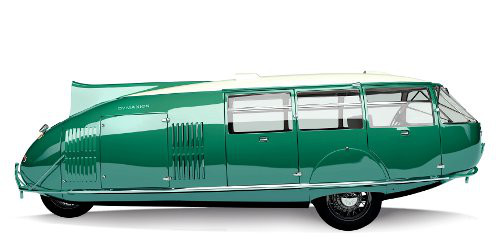
The Dymaxion car designed by inventor–architect Buckminster Fuller.
The Dymaxion car was a concept car designed by U.S. inventor and architect Buckminster Fuller in 1933. The word Dymaxion is a brand name that Fuller gave to several of his inventions, to emphasize that he considered them part of a more general project to improve humanity's living conditions. The car had a fuel efficiency of 30 miles per US gallon (7.8 L/100 km; 36 mpg-imp). It could transport 11 passengers. While Fuller claimed it could reach speeds of 120 miles per hour (190 km/h), the fastest documented speed was 90 miles per hour (140 km/h).
Isamu Noguchi was involved with the development of the Dymaxion car, creating plaster wind tunnel models that were a factor in determining its shape, and during 1934 drove it for an extended road trip through Connecticut with Clare Boothe Luce and Dorothy Hale.

The Dymaxion car was a three-wheeler, steered by a single rear wheel, and could do a U-turn in its own length. However, the rear-wheel steering made the car somewhat counterintuitive to operate, especially in crosswind situations. The body was teardrop-shaped in the manner designed by Aurel Persu, and naturally aerodynamically efficient. The car was twice as long as a conventional automobile, at 20 feet (6.1 m) long. Drive power was provided by a rear-mounted Ford V8 engine, (See: RF →) which produced 85 brake horsepower (63 kW; 86 PS) through the front wheels. The front axle was also a Ford component, being the rear axle of a contemporary Ford roadster turned upside-down.

The 1929 automobile of German inventor and helicopter pioneer Engelbert Zaschka exhibited features that were important to Buckminster Fuller. Zaschka's three-wheeled car could also easily be folded, disassembled and re-assembled, as could Fuller’s Dymaxion House and many geodesic domes.

An accident at the 1933 Chicago World's Fair damaged the first prototype badly, killing the driver, and seriously injuring the two passengers, one of whom was William Sempill, aviation pioneer and Japanese spy. The Dymaxion had rolled over, and although the driver was wearing a seatbelt, the prototype's canvas roof had not offered sufficient crash protection. The cause of the accident was not determined, although Buckminster Fuller reported that the accident was due to the actions of another vehicle that had been following the Dymaxion closely. The crash prompted investors to abandon the project, blaming the accident on deficiencies of the vehicle's steering.
In his 1988 book The Age of Heretics, author Art Kleiner maintained the real reason Chrysler refused to produce the car was because bankers had threatened to recall their loans, feeling the car would destroy sales for second-hand cars and for vehicles already in the distribution channels.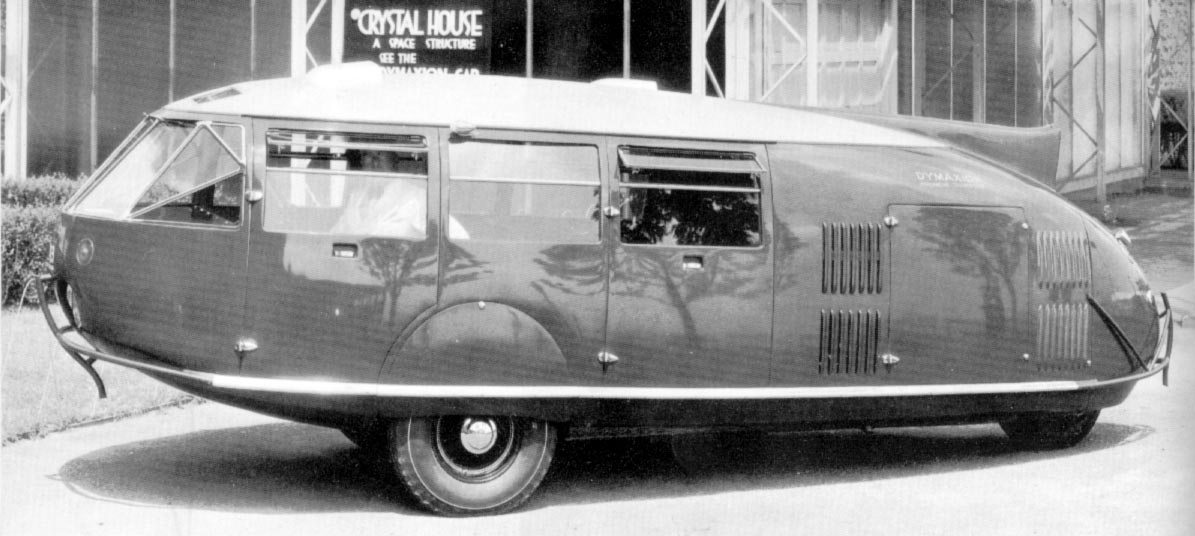
Although the Dymaxion cars were not produced, the design was influential on several subsequent designs. The most widespread example of its influence was the Fiat 600 Multipla, where an extreme rear-mounted engine and a driver position above the front axle was used to give an extremely compact hybrid of car and van, which could either seat 6 people, or be used for moving bulky loads.Buckminster Fuller's Dymaxion concept of obtaining optimal efficiency by Aurel Persu's aerodynamic design and employing the most advantageous materials, although obvious, may have especially influenced such designs as the Aptera hybrid car prototype, which, like the Dymaxion, is a three-wheeled, ultra light, aerodynamic, fuel-efficient vehicle design.

There were 3 original cars: car 1 was badly damaged; car 2 survives in the Harrah Collection of the National Automobile Museum in Reno, Nevada; and car 3 changed hands many times but was lost, presumed scrapped, in the 1950s. In October 2010, architect and student of Buckminster Fuller, Sir Norman Foster, had recreated the Dymaxion, producing car number 4.
Extensive research was carried out during the manufacture of car 4 in an attempt to replicate the interior of the original Dymaxion cars. Having completed the interior of car 4, O'Rourke Coachtrimmers was selected to restore the interior of the only surviving original, car 2. Car 2 was shipped to Rudgwick in order for the work to be carried out before returning to the National Automobile Museum in Reno, Nevada
The Dymaxion car is the subject of a film by filmmaker and comedian Noel Murphy: The Last Dymaxion: Buckminster Fuller's Dream Restored. The film has been written up in the New York Times, prompting an October 2011 lecture and screening at Yale University.
Czech restoration company Ecorra is building a replica for the Lane Motor Museum in Nashville, Tennessee.
-
That was a perfect car for a country that was just starting to develop modern superhighways, but can you imagine trying to park that beast somewhere? :ahhh
I find concept cars to be a really cool concept in their own right. Take for example the Pontiac Aztek:

As the story goes, this was a concept car that was intended to show a number of features that were expected to be in the next generation Tahoe, Suburban and various other trucks and minivans in the GMC/Chevrolet/Pontiac lines- things like the built in cooler, molded tail gate seats with fold out speakers, tent attachments and so on, and the shape was designed to draw people to it at car shows. It was never meant to go into production- it was supposed to be a radical design to attract attention, that could then be channeled towards the "important" features that would start showing up on various other models.
Somewhere along the line people started to associate the Aztek and the features as a single unit rather than things that will be available elsewhere and demand for this thing grew- although people wanted the convenience it offered, not the truck itself. The decision was made to put it into production, and it was a colossal failure, despite the number of convenient options in it. Because the Aztek was a failure and it had become synonymous with all the neat features, most of those things never really made it to other vehicles. It really was like throwing the baby out with the bath water- GMC didn't want to taint their bread and butter truck line with the failure of the Aztek so none of the cool features ever really made it to their truck line as originally intended.
It was a concept that was never meant to go into production, but did and as a result, killed the rest of the good concepts on board. Pretty neat when you think about it. :D
Def
-
The Aztek is a cool rig, it was just made to look very un-cool! Get rid of the horrible plastic, give it a few more inches of ground clearance, AWD and bigger tires, and you'd have a good light trail/camping rig.

This isn't too bad, minus the stupid plastic.

This maybe a little too far, but somewhere between that and stock would be alright.








 .


Hello! It looks like you're interested in this conversation, but you don't have an account yet.
Getting fed up of having to scroll through the same posts each visit? When you register for an account, you'll always come back to exactly where you were before, and choose to be notified of new replies (either via email, or push notification). You'll also be able to save bookmarks and upvote posts to show your appreciation to other community members.
With your input, this post could be even better 💗
Register Login


